
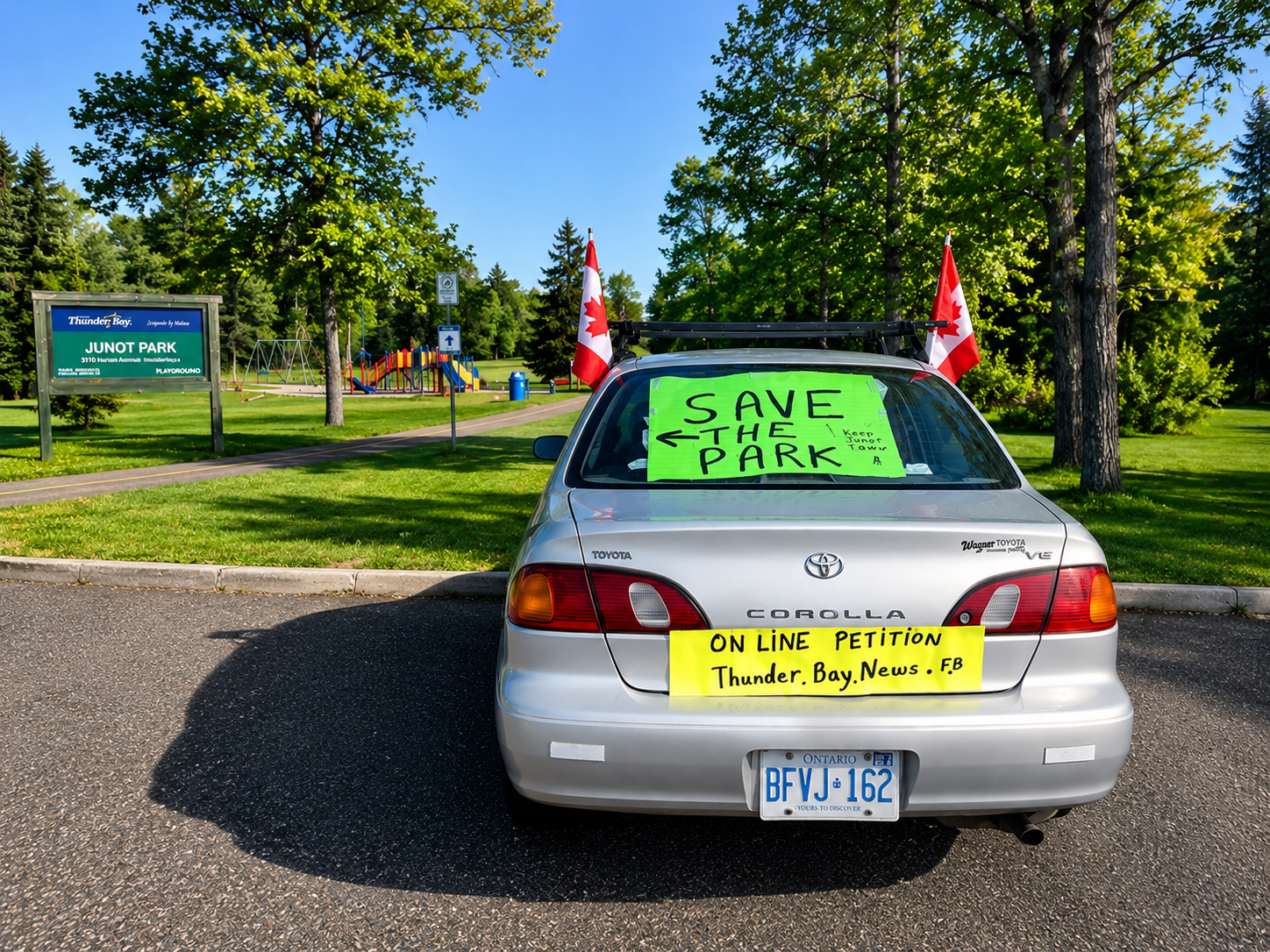

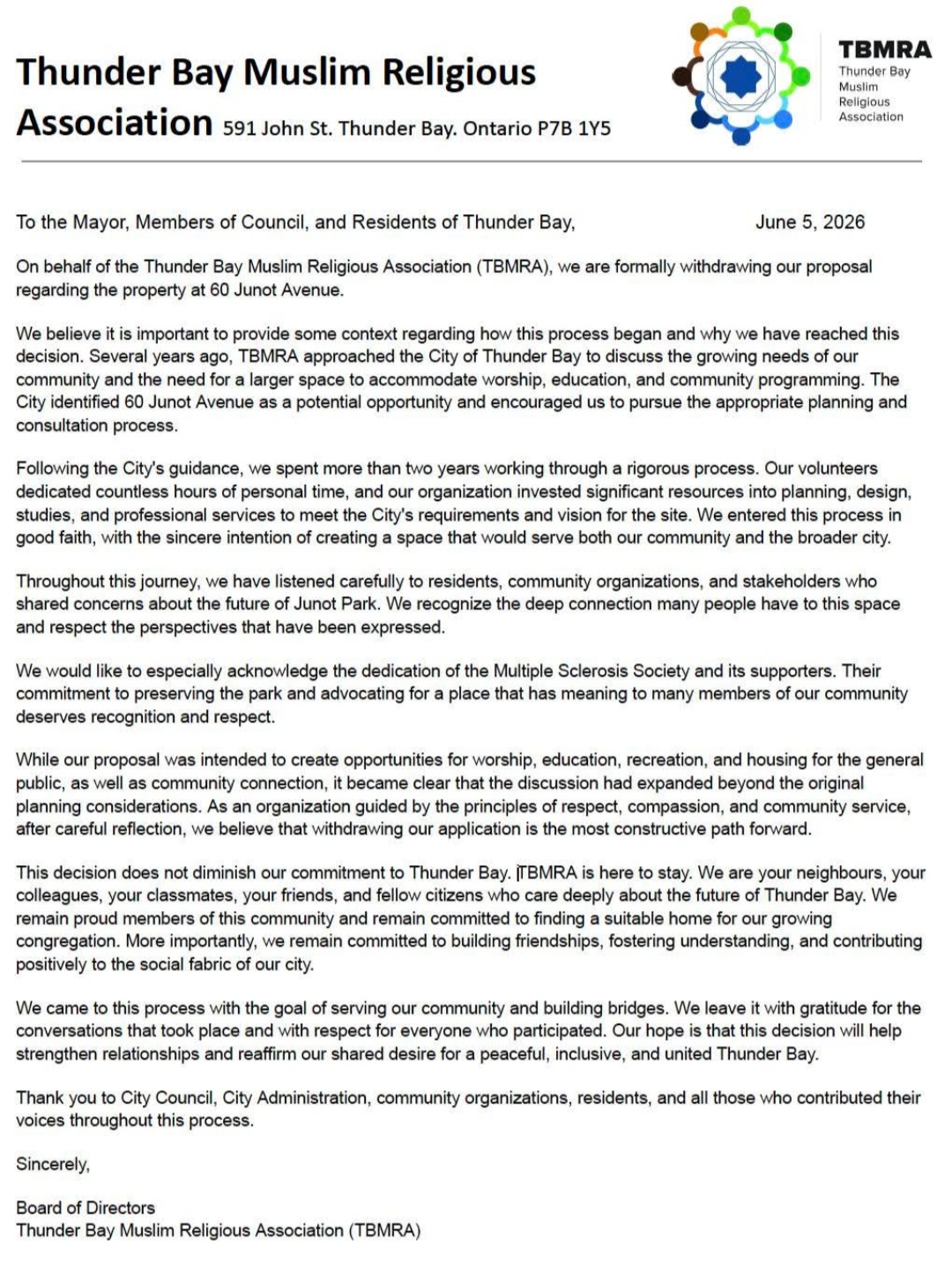
Today, the Thunder Bay Muslim Religious Association withdrew its proposal to develop a faith-based community campus within Junot Park.
For supporters of the park, the announcement came as a relief. For supporters of the project, it was undoubtedly disappointing.
But beyond the debate over the proposal itself, the withdrawal exposed something far more significant: a growing crisis of public trust between Thunder Bay residents and their municipal government.
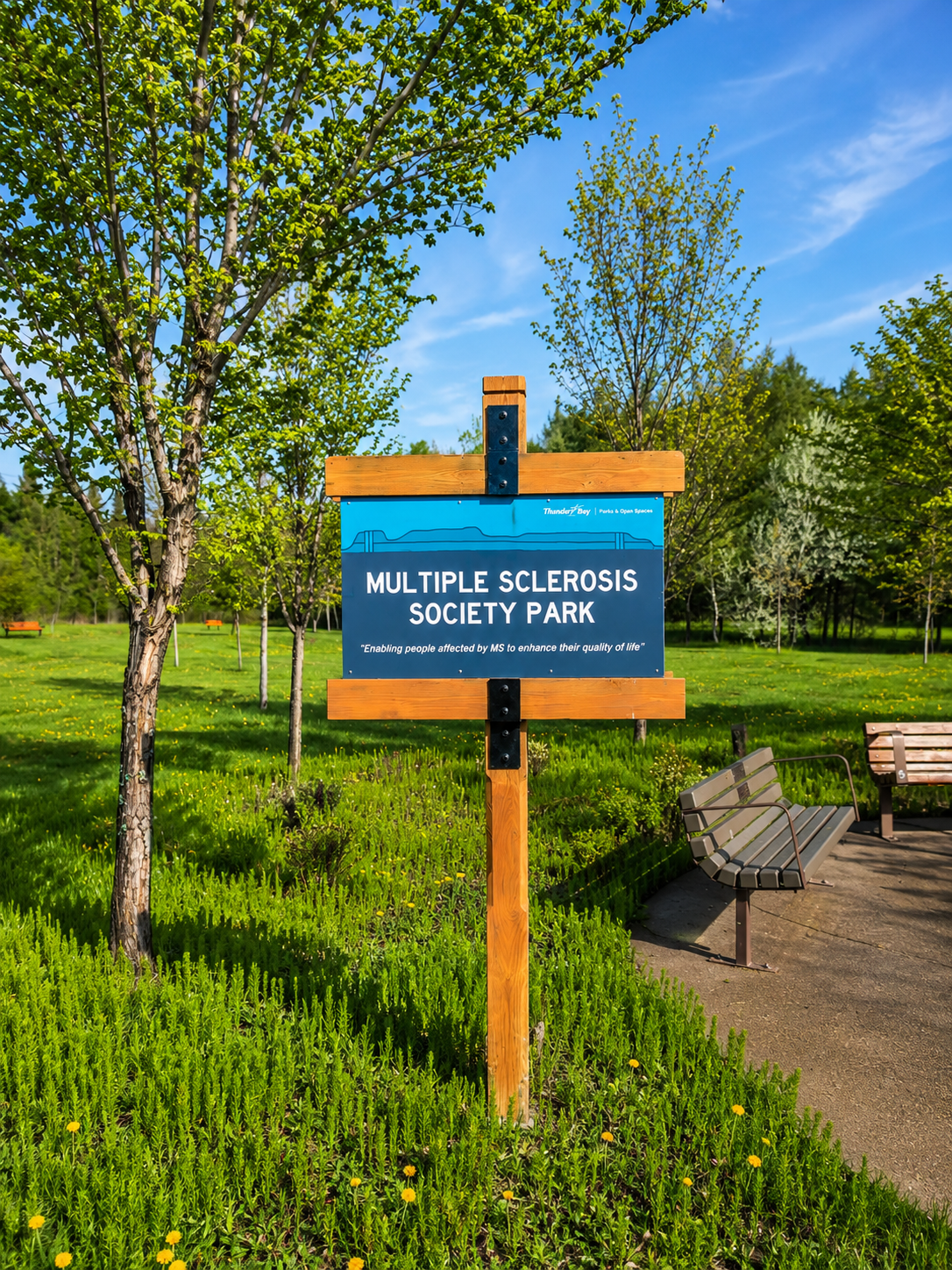
The proposal first came to public attention only weeks ago when residents learned that a portion of Junot Park could be transferred for development. The project would have included educational, recreational, and community facilities. It also would have occupied land within a public park that contains the Multiple Sclerosis Society Park, a memorial space created through community donations and years of volunteer support.
The reaction was immediate.
Residents questioned why parkland was being considered for development at all. Others questioned why publicly funded greenspace was being treated as available land when vacant lots, underutilized properties, struggling commercial corridors, and brownfield sites remain scattered throughout the city.
Then came the withdrawal.
In its announcement, the Thunder Bay Muslim Religious Association (TBMRA) acknowledged the concerns raised by residents, recognized the significance of the park to the broader community, and specifically expressed respect for the advocacy of the Multiple Sclerosis Society and its supporters.
Whether one agreed with the proposal or opposed it, the organization applicants did something noteworthy.
They listened.
And in doing so, exposed a growing frustration many residents have with City Hall itself.
For years, the City of Thunder Bay has promoted consultation, engagement, and public participation. Residents are invited to meetings. Surveys are distributed. Feedback is collected. Public input is encouraged.
Yet many residents increasingly view these exercises not as opportunities to influence decisions, but as opportunities to react to decisions that have already been made.
The proposed development of the 791 Arundel greenspace illustrates why.
Residents organized petitions, attended meetings, submitted feedback, and appeared before Council. Yet throughout the process, many were left with the impression that public opinion was being filtered through a framework designed to support development rather than evaluate it.
Citizen-led petitions were discounted.
Neighbourhood opposition was frequently characterized as resistance to housing rather than concern for the loss of parkland.
Survey findings were presented in ways that many residents felt were grossly underrepresented by the community response rate and failed to accurately capture the concerns being expressed.
Questions focused on housing needs without equally exploring whether parks should be used to address those needs.
Support for affordable housing was frequently interpreted as support for development on specific greenspaces.
Complex community concerns were reduced to simple and misleading percentages.
The result was not merely disagreement over the finding but also growing skepticism about the process itself.
The problem is not that every resident expects City Hall to agree with them but that many residents no longer believe their participation meaningfully changes anything.
Perhaps no example better illustrates the issue than an email sent by Mayor Ken Boshcoff on January 6, 2026, in response to a resident encouraging Council to reject the Arundel surplus designation.
In his reply, the Mayor expressed hope that residents would understand and accept Council’s “debated and approved decision” regarding the lands.
BUT the debate and vote had not yet occurred.
To residents already questioning whether decisions are truly being made in public, the message reinforced a troubling perception: that public meetings are increasingly formalities rather than forums where decisions are genuinely being made. And it begs the question, “Are Mayor and Council making decisions in council chambers or in the halls -and backrooms, of City Hall?”
Trust in our elected representatives depends upon confidence in transparency of the decision-making process. And in Thunder Bay, confidence in our Mayor and Council is becoming increasingly difficult to maintain.
And this is why the Junot Park story is so significant.
The most remarkable aspect of the withdrawal was not that a proposal failed -development proposals fail all the time. The remarkable part was that the applicant changed course.
The organization that had invested time, resources, and planning into the project ultimately demonstrated a willingness to reconsider its position in response to community concerns.
Many residents cannot recall the last time City Hall did the same.
The irony is difficult to ignore.
The organization, invited by the City to develop in the park, ultimately appeared more responsive to public concerns than the municipal government that identified the site as a development opportunity in the first place.
Junot Park may have been spared but the larger question is whether City Hall has learned anything from the experience.
Parks can be protected, projects can be withdrawn, and policies can be amended. But once public trust begins to erode, it is difficult to recover. In an election year, Council members may discover that public trust is far more difficult to rebuild than a park.

