
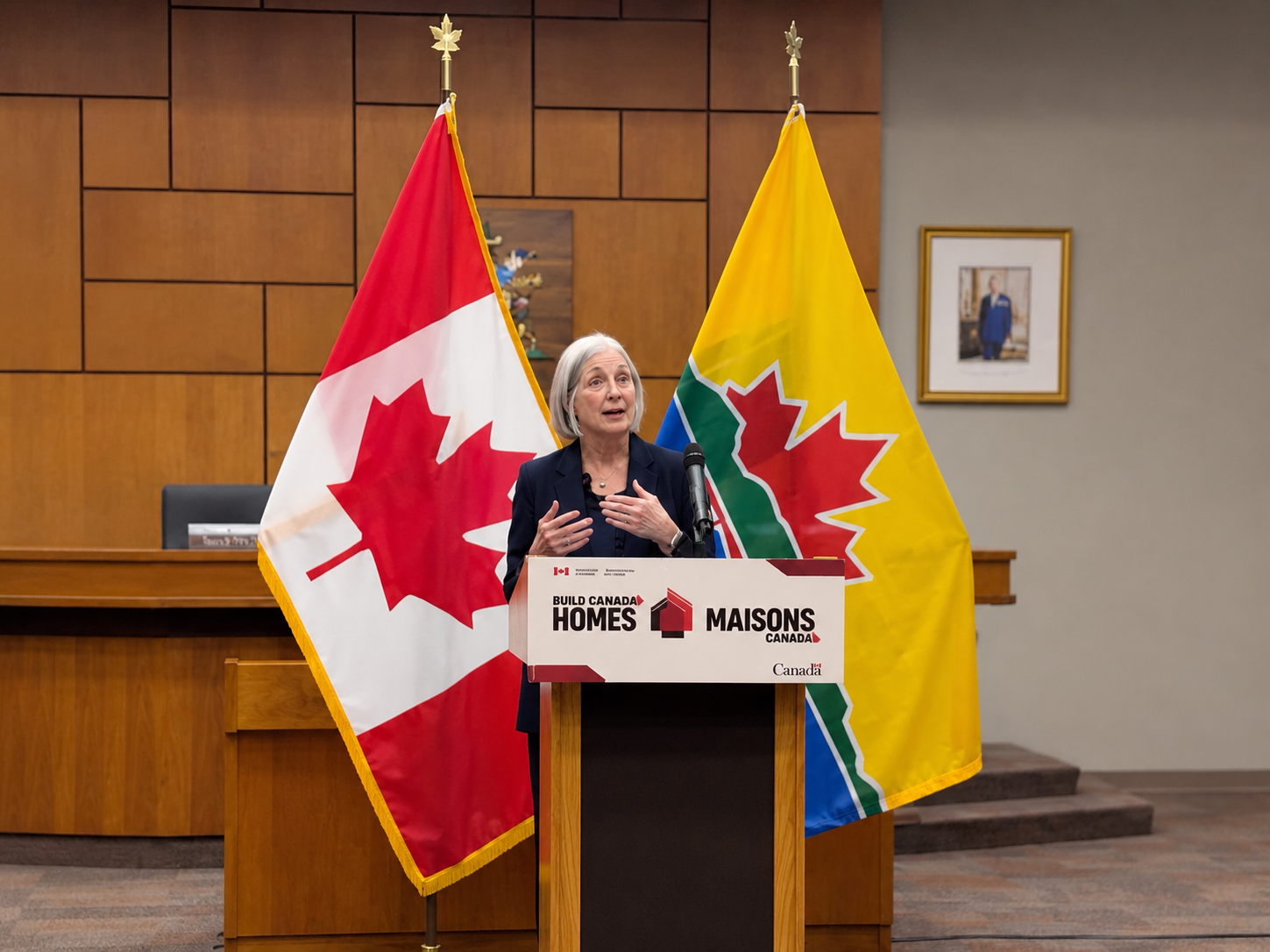

Federal Minister and Thunder Bay – Superior North MP Patty Hajdu arrived at Thunder Bay City Hall on July 10 bearing congratulations.
The City, she said, had exceeded its provincial housing targets -again, and had become a top performer in the federal Housing Accelerator Fund receiving approximately $20.7 million initially and another $2.07 million as a reward for its performance.
Then came the applause line that may have surprised anyone who has been following Thunder Bay’s actual housing decisions, when Hajdu stated:
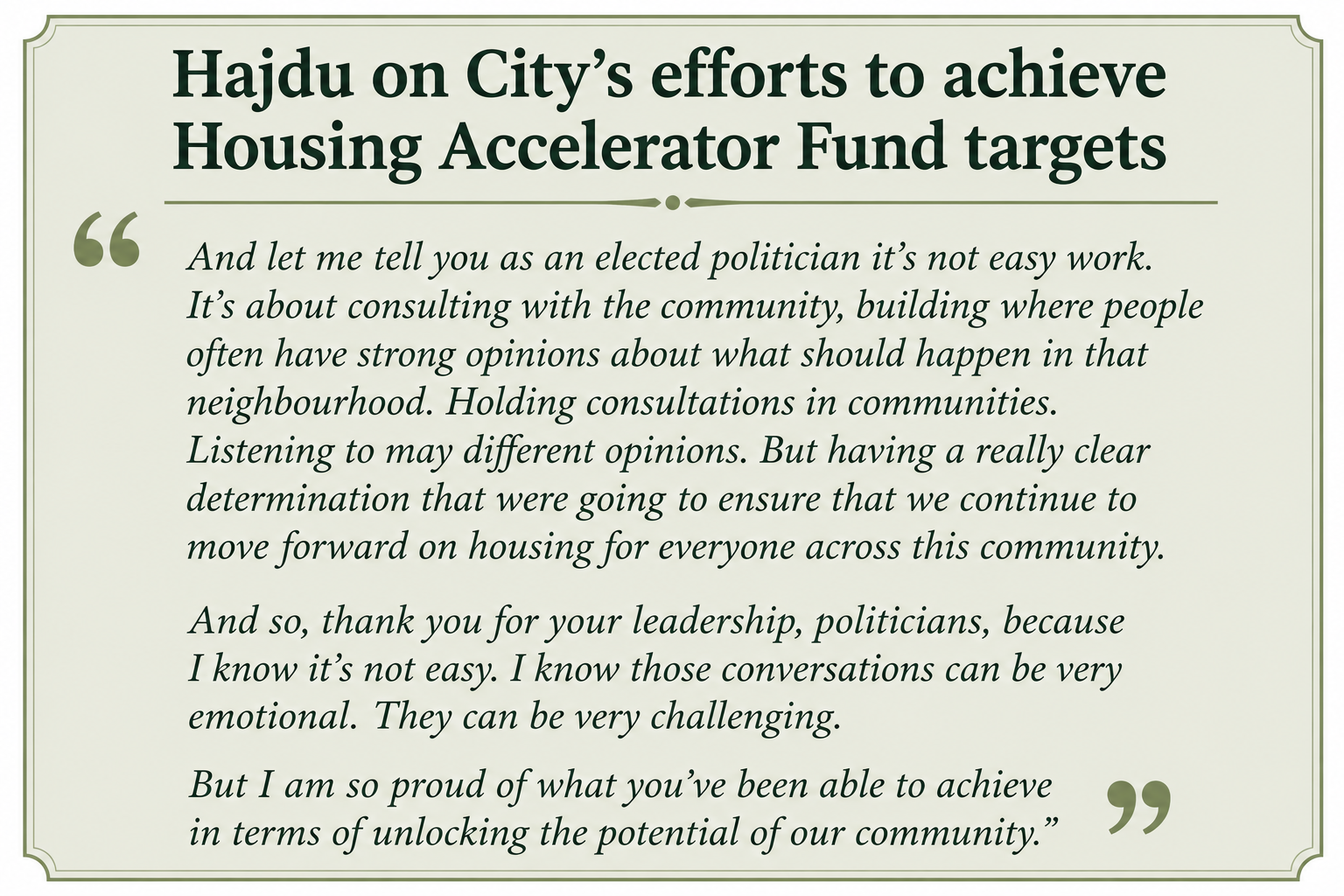
“And I will note that your work to make sure that abandoned properties are cleaned up and are available is a big piece of the puzzle in the urban infill that Thunder Bay has chosen to pursue vigorously and something that I think we are all proud of.”
Apparently, Hajdu didn’t get THE MEMO that set Thunder Bay’s parkland strategy in motion. If she had, her congratulatory speech might have sounded very different.
Thunder Bay has not spent the past several years vigorously transforming abandoned and dilapidated properties into housing sites. Its Vacant and Dilapidated Buildings Program is new. The City requested additional Housing Accelerator Fund money to create it in 2025. As late as November 2025, the program was still being developed, its phases and definitions were still being discussed, and a further report was expected in 2026. The 2026 City budget added a coordinator position to help implement it.
The program is intended to incentivize 64 housing units.
That may be worthwhile work and may eventually produce results. But there is a rather large difference between announcing a program to begin addressing vacant buildings and praising a city for work it has supposedly already done.
While the federal government was incorrectly congratulating Thunder Bay for cleaning up abandoned properties, the City was moving toward something much easier: taking publicly owned land -including established parkland, and offering it to developers. (See the Thunder Bay Muslim Religious Association/Junot Park HERE.)
Council’s direction began on March 6, 2023, when Councillor Kasey Etreni issued a MEMO directing Administration to identify City-owned lands available for potential surplus and sale. The direction explicitly included parkland and asked staff to prioritize properties capable of bringing the City the greatest financial benefit.
This was not a reluctant last resort reached after Thunder Bay had exhausted its abandoned buildings, vacant lots, brownfields, derelict commercial properties, and neglected urban sites.
The City’s vigorous pursuit of infill -PARKLAND EDITION
Parkland was placed on the table from the beginning.
That direction eventually helped produce a list of so-called “Opportunity Sites,” including the 791 Arundel parkland -a property recognized by residents as a park, used as parkland for generations, connected to trails and natural systems, and designated and zoned for community use.
City documents now call it “vacant lands.”
There is some impressive linguistic efficiency involved in turning a park into vacant land. First, remove its history. Then remove its community use. Then remove its ecological function. Finally, describe what remains as an underutilized municipal asset waiting to be “unlocked.”
The City’s December 2025 report described identifying City-owned lands for surplus and sale as a “fundamental” component of its Housing Accelerator Action Plan. It also tied this work directly to the March 2023 direction to include parkland and seek the highest financial benefit.
There was nothing accidental about parkland finding its way onto that list.
During Council debate, Councillor Shelby Ch’ng introduced an amendment that would have changed the motion from identifying lands “including parkland” to “excluding parkland“. The amendment was seconded by Councillor Greg Johnsen but ultimately defeated through Council vote.
In other words, Council was presented with a clear opportunity to remove parks from consideration before the process even began. They chose not to. The inclusion of parkland was not an administrative oversight or an unintended consequence of the Housing Accelerator Fund. It was a conscious policy choice made in full view of Council.
So, when Hajdu congratulated Thunder Bay for vigorously pursuing urban infill through abandoned properties, she omitted the more uncomfortable part of the strategy:
The City has also been vigorously pursuing its parks.
Consultation as ceremonial theatre
Hajdu also acknowledged that housing decisions can be difficult:
“It’s about consulting with the community, building where people often have strong opinions about what should happen in that neighbourhood…listening to many different opinions. But having a really clear determination that we’re going to ensure that we continue to move forward…”
There it is.
Consult. Listen. Then continue moving forward with the determination already established.
Public consultation is apparently important -but not necessarily because it might change anything.
That interpretation is difficult to avoid in the case of the 791 Arundel parkland.
The City presented concepts for four different properties and conducted one online survey covering all four. It received only 142 survey responses in total.
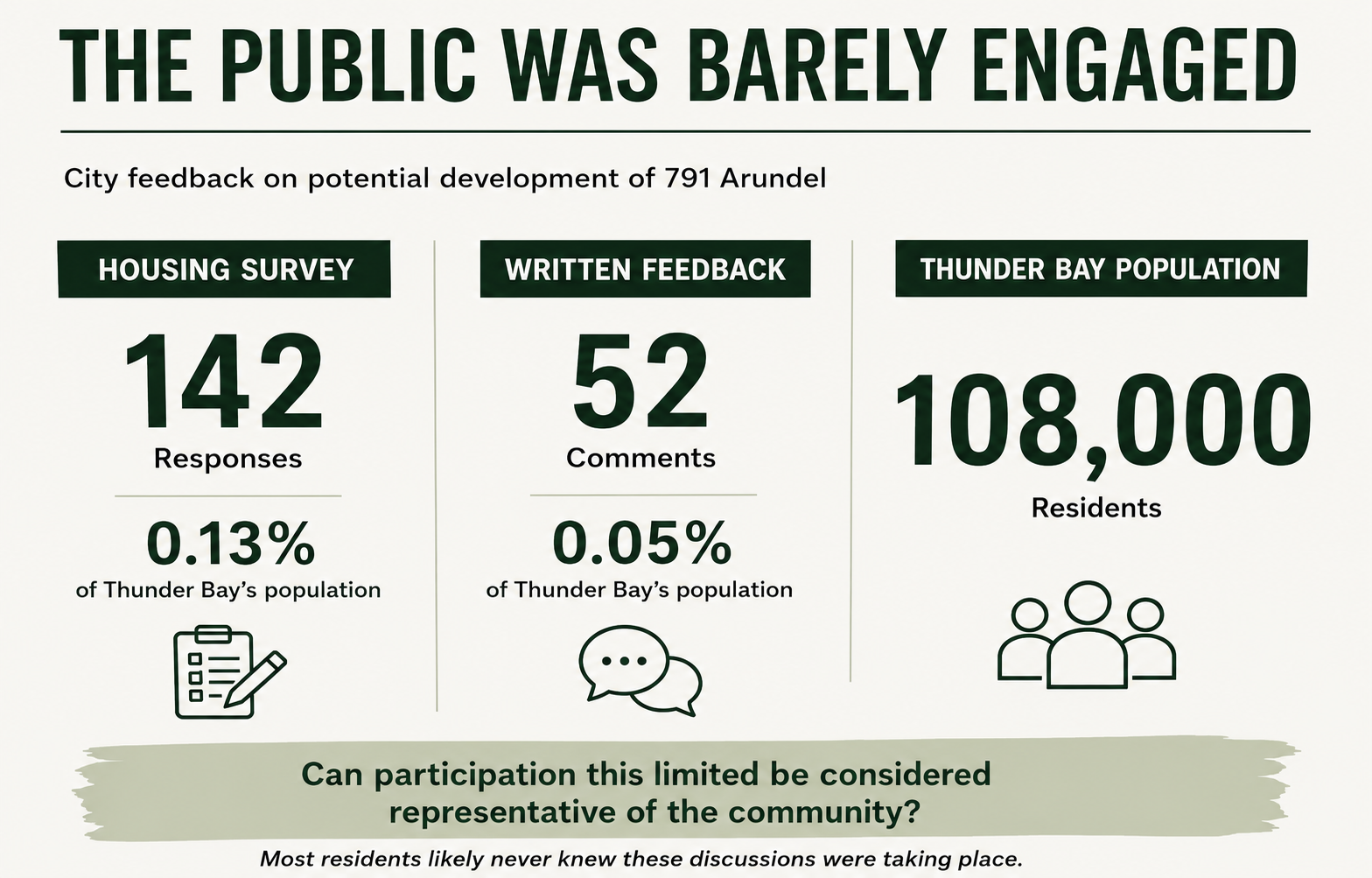
In a city of approximately 108,000 people, that represents about 0.13% of the population.
Those 142 people were not all commenting on Arundel. They were answering questions concerning four separate proposed development sites.
The City also received direct written feedback and inquiries regarding individual properties. Regarding the Arundel parkland, 52 people provided comments -approximately 0.05% of Thunder Bay’s population.
Those responses were hardly a mandate to remove the park from public ownership:
- 41 people emphasized the importance of the trails, greenspace and wildlife habitat;
- 33 raised traffic and pedestrian-safety concerns;
- 23 objected to the proposed density;
- 8 expressed concern about infrastructure capacity;
- and only 8 expressed support for increased housing development at the site.
The survey asked people whether the City should support infill development during a housing shortage. Unsurprisingly, most said yes.
But supporting infill does not mean supporting every proposed location. It certainly does not mean endorsing the conversion of an established park into a high-density residential site.
Asking residents whether they support housing and then using that answer to justify building on parkland is like asking whether people support new schools and interpreting “yes” as permission to demolish the neighbourhood library.
The early optics suggested that the public was being invited into a genuine decision-making process.
Signs appeared. A survey was posted. Open houses were held. Staff received comments. Residents were told there would be future opportunities to participate.
But the City had already issued its call for development proposals before the surplus debate occurred. Developers had already submitted concepts. Preferred proposals had already been identified. Renderings had already been produced. The public was introduced to a process that was well underway and then invited to comment on the direction it was already travelling.
Perhaps the clearest example of that perception came in an email exchange between Mayor Ken Boshcoff and resident Catherine Courtine. Before Council had debated or voted on whether to declare the 791 Arundel parkland as surplus, Courtine emailed the Mayor urging him to keep the parkland off the surplus list. In his reply, Mayor Boshcoff wrote that he hoped Courtine would “understand and accept Council’s debated and approved decision to utilize such surplus lots which must be maximized to keep our taxes low and indeed ensure our services reach the most number of taxpayers at continued low costs.”
Courtine responded later that same morning, reminding the Mayor that Council had not yet debated or approved the matter. She wrote that it made her “sad and angry” because “the democratic process seems to be useless, because you [Mayor] consider the decision a done deal.”
Whether or not that was the Mayor’s intention, the exchange illustrates why many residents questioned whether the public process remained genuinely open. Consultation should occur while alternatives remain open. Consultation should be capable of changing an outcome. Consultation is not meaningful when residents are brought in after the machinery has begun moving and asked to become comfortable with where it is taking them.
Hajdu’s speech unintentionally captured that approach perfectly: listen to the opinions, acknowledge the emotions, and maintain a “clear determination” to move forward.
Follow the money -but mind the trees
The federal Housing Accelerator Fund creates an unmistakable incentive structure.
Thunder Bay was approved for up to approximately $20.7 million, distributed through four advances. The second and third payments were conditional on implementing the approved Action Plan. The final payment depended on meeting the City’s housing-growth target. After exceeding its first-year target and being classified as a top-performing municipality, Thunder Bay received approximately $2.077 million in additional funding.
The City was therefore not merely encouraged to increase permits. It was financially rewarded for doing so. But the federal government did not order Thunder Bay to build in parks. City Council simply chose to be open to sacrificing parklands to respond to the financial incentive.
The City could have concentrated relentlessly on derelict properties, abandoned buildings, brownfields, vacant industrial land, empty upper-storeys, underused commercial sites, and neglected downtown parcels.
In fact, the City’s own Housing Land Needs Study concluded that Thunder Bay has sufficient land to accommodate its projected housing needs under all examined growth scenarios.
The Housing Accelerator Action Plan itself identified 406 vacant industrial properties and 42 hectares of smaller industrial parcels for assessment and possible residential conversion. It emphasized additional dwelling units, multiplexes, development incentives, faster approvals, strategic core-area infill and neighbourhood planning.
The list of viable alternatives continues to grow. Since this process began, the proposed Inter-Ocean redevelopment has emerged as another major housing opportunity. At roughly thirteen times the size of the 791 Arundel parkland, the site has been identified as capable of accommodating approximately 1,260 homes. Its emergence reinforces an important point: Thunder Bay’s housing future has never rested on the fate of a single neighbourhood park.
Yet somewhere along the way, “urban infill” expanded to include a park beside a natural corridor -as well as the Active Living corridor on Arundel, including the mere 3 hectares that make up the Arundel parkland.
Perhaps abandoned properties are complicated. They can require enforcement, acquisition, demolition, environmental remediation, and patient redevelopment.
Parkland is easier.
The City already owns it.
And if it can be relabelled “vacant,” the trees, the meadow, and the wildlife apparently become a paperwork problem.
The incentive structure is therefore worth stating plainly: Thunder Bay receives financial rewards for accelerating housing permits, while the environmental, recreational, and community costs of sacrificing public greenspace are borne locally and permanently.
The federal reward arrives once.
The park disappears forever.
Recreation is essential -except where housing might fit
The richest irony in Hajdu’s speech arrived only moments later.
She explained that employment and housing are not enough to make people choose a community:
“If you can’t envision yourself living in a community, whether it’s because of not affordable housing, because there’s not recreation, because there’s not something for your children and families to do -the job is just a job.”
Exactly.
People need housing.
They also need recreation, natural spaces, trails, safe places for children, trees, wildlife corridors, and neighbourhoods in which life consists of more than occupying a residential unit and driving to work.
That is precisely why the 791 Arundel parkland is so vital to our neighbourhood. This parkland is not an obstacle to community-building -it is part of the community.
The federal government cannot sensibly praise recreation as an essential ingredient of livable cities while local officials treat existing recreational greenspace and parkland as disposable inventory. Nor can Thunder Bay claim to be building complete communities while dismantling one of the things that already makes a neighbourhood complete.
A city does not solve one shortage by creating another.
The catalogue is not the culprit
The announcement itself concerned Thunder Bay becoming a local partner in the federal Housing Design Catalogue.
The catalogue contains more than 50 standardized, low-rise designs intended to reduce architectural costs, streamline local approvals and make it easier for homeowners and small builders to construct houses, multiplexes and gentle-density projects. Thunder Bay will pre-review designs so that they can move more efficiently through the local approval system.
There is much to like about that idea.
This federal initiative can help families, non-profit organizations, Habitat for Humanity, and smaller developers. And as a planning tool, may make additional dwelling units and modest multiplex projects easier to build, while reducing costs and delays that have little to do with safety or sound planning.
But the Housing Design Catalogue does not explain why Thunder Bay needs to sacrifice parkland.
If anything, it provides another way to increase housing supply through gentle-density on already developed residential land.
Pre-approved designs, backyard homes, conversions, multiplexes, and streamlined permits should reduce pressure to consume public greenspace -not become part of the public-relations package used while it happens.
The picture wasn’t complete
Hajdu’s speech painted a flattering picture: a courageous municipal government consulting extensively, cleaning up abandoned properties, pursuing urban infill, protecting recreation and unlocking housing potential.
There are pieces of that picture that are true.
The City has: increased housing permits; created incentives; is streamlining approvals; is supporting new construction; and is beginning to develop a program for vacant and dilapidated buildings.
But the picture omitted the parkland strategy.
And it omitted the tiny consultation numbers.
And that only 8 of the 52 direct Arundel respondents expressed support for increased housing there.
And that Council’s original surplus-land direction explicitly included parks and emphasized financial return.
And that a decision appeared to be taking shape well before the public was invited to comment on it.
And that the same City being praised for understanding the importance of recreation is proposing to remove a long-used recreational and natural space from public ownership.
Thunder Bay needs housing.
And Thunder Bay also needs honest consultation, transparent decisions, and a municipal government capable of distinguishing urban infill from filling in a park.
Before the next round of congratulations, somebody should send Patty Hajdu the memo.

Primary Sources
2. Housing Accelerator Fund Action Plan
3. Corporate Report 138-2024 – Housing Accelerator Fund Funding Allocation Plan
4. Corporate Report 387-2025 – Surplus Declaration: Call for Proposals – 4 Opportunity Sites
5. Report 143-2026 – Housing Accelerator Fund – 2026 Annual Report
6. Thunder Bay Housing Land Needs Study
7. Standing Committee Recommendation – Surplus Declaration: Call for Proposals – 4 Opportunity Sites
8.Email correspondence between Mayor Ken Boshcoff and Catherine Courtine, copied to Thunder Bay City Council, Steffanie Petroni, and the Chronicle Journal (January 6, 2026)
