
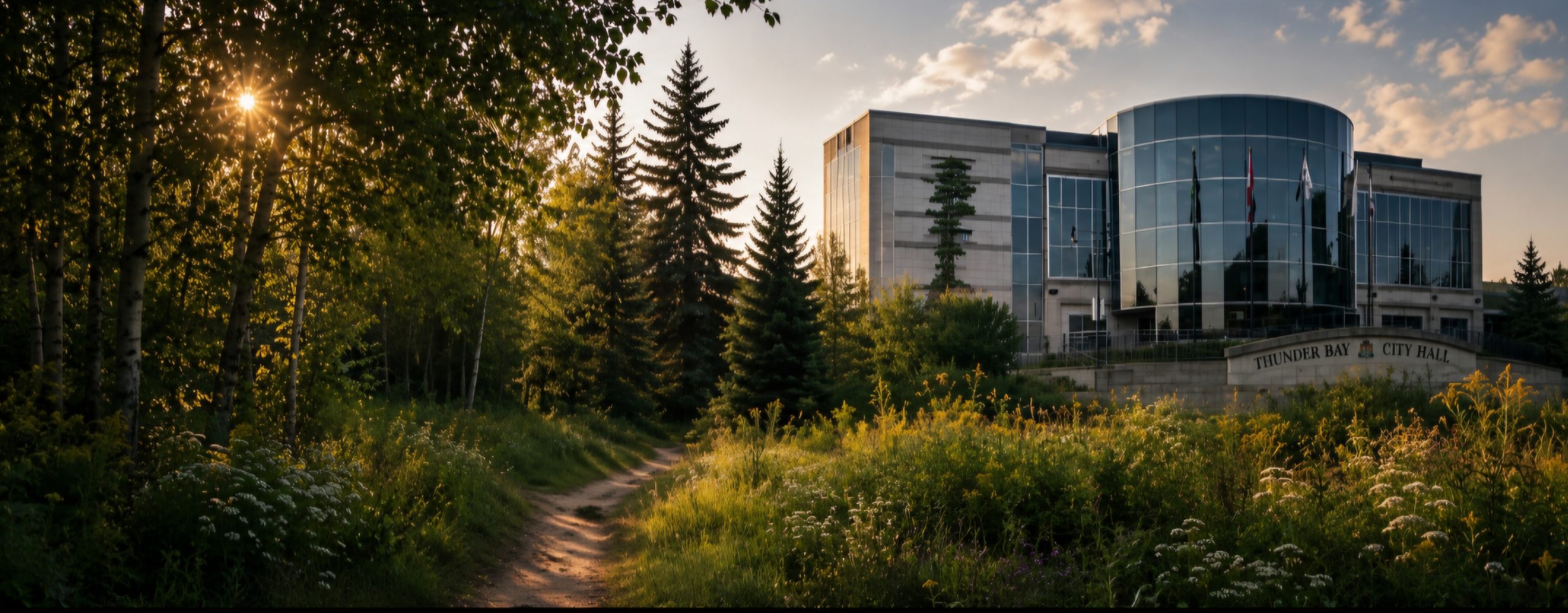

Part Two of a Northern Hoot examination of population forecasts, housing need, public land, and the City’s decision to include neighbourhood parkland among its housing Opportunity Sites. Part One can be read here: Thunder Bay’s Housing Panic: The Numbers Do Not Lead to Arundel
In the first article of this series, we examined whether Thunder Bay required extraordinary measures to address its housing needs. The City’s own Housing Land Needs Study concluded that it did not. The study identified capacity for approximately 19,800 housing units while projecting a need for fewer than 8,900 over the planning horizon. Simply put, the City had identified enough development capacity to accommodate future growth without relying on 791 Arundel.
That finding raises an obvious question.
If Thunder Bay already had sufficient capacity, why was a neighbourhood park selected for redevelopment?
Information obtained through a Municipal Freedom and Protection of Privacy request submitted by Lori Santink, TBay Greenspace Preservation, begins to answer that question -not by explaining why Arundel was chosen, but by revealing what City staff already understood before the public debate had even begun.
In May 2025, as the City worked with planning consultant Stantec on its Opportunity Sites initiative, Aaron Ward, Project Manager of Development Services, described 791 Arundel as “the most politically/neighbourhood sensitive parcel.”
That single sentence changes the context of the debate.
It tells us that City staff recognized, long before Council declared the property surplus and long before residents organized in opposition, that Arundel was fundamentally different from the other lands under consideration. This was not simply another vacant parcel or underutilized municipal property. Internally, it was acknowledged as the most politically and neighbourhood-sensitive site in the entire group.
The significance of that statement is not that residents eventually opposed the development. Anyone can see that today.
The significance is that the City anticipated the sensitivity before the public process unfolded.
Yet the documents show that work on the site continued.
In the same correspondence, Aaron Ward asked consultants at Stantec to prepare conceptual development scenarios for several City-owned properties being considered for surplus. The purpose was to establish what he described as the “highest and best use” of the lands so that future development proposals could be evaluated against those concepts. The 791 Arundel parkland was among the properties identified for this work.
Additional documents show the City commissioning environmental assessments, archaeological investigations, and existing conditions studies for Arundel as the project advanced.
Taken together, these records reveal something important.
By the time the public was first notified that Arundel was being considered for redevelopment, the City had already begun imagining development concepts, assessing environmental constraints, and preparing the technical work necessary to move the property through the redevelopment process.
The story had begun well before residents learned that Arundel was under consideration.
Public opposition has largely focused on the proposed loss of the 791 Arundel parkland, a long-established neighbourhood park used by generations of residents. Alongside those concerns, residents have raised legitimate planning questions about the proposal’s height, density, traffic impacts, environmental effects, and compatibility with the surrounding neighbourhood. But all of those issues arose only after a much more consequential decision had already been made -the decision to place the 791 Arundel parkland on the table.
And that decision was not driven by a shortage of land.
According to the City’s own Housing Land Needs Study, Thunder Bay already possessed sufficient development capacity to meet projected housing demand. Arundel was therefore not required to satisfy the City’s long-term housing needs. The decision to include it among the Opportunity Sites was a planning choice, not a demographic necessity.
As attention turned to the details of the proposal, the earlier decision to identify the parkland for redevelopment faded from both public discussion and Council debate.
Once Arundel entered the Opportunity Sites program, the conversation shifted from whether the parkland should be developed to what kind of development should occur there. The terms of the debate changed. Consultants prepared development concepts. Technical studies proceeded. Developers were invited to compete.
The loss of confidence extends well beyond the 791 Arundel parkland itself.
Residents point to the recent conceptual plans prepared by Stantec- the fourth iteration, which illustrate a potential future road connection extending from the 791 Arundel parkland toward the 755 Arundel parkland. While the City has repeatedly stated that only the 791 Arundel parkland is currently under consideration, many residents fear the proposal represents the first phase of a much larger redevelopment strategy.
Those concerns have only intensified as additional information has emerged incrementally rather than through proactive public disclosure. Whether those concerns ultimately prove well-founded is beside the point.
Trust is the foundation of effective public planning. When residents believe they are learning about significant planning decisions only after they are substantially underway, confidence in the process begins to erode.
Perhaps the greatest casualty of the Arundel process has not been the parkland -at least not yet. It has been public confidence. Once trust in the planning process -and in those responsible for it, is lost, every future proposal is met not with curiosity, but with suspicion. And that may prove to be the City’s most difficult problem to solve.

