
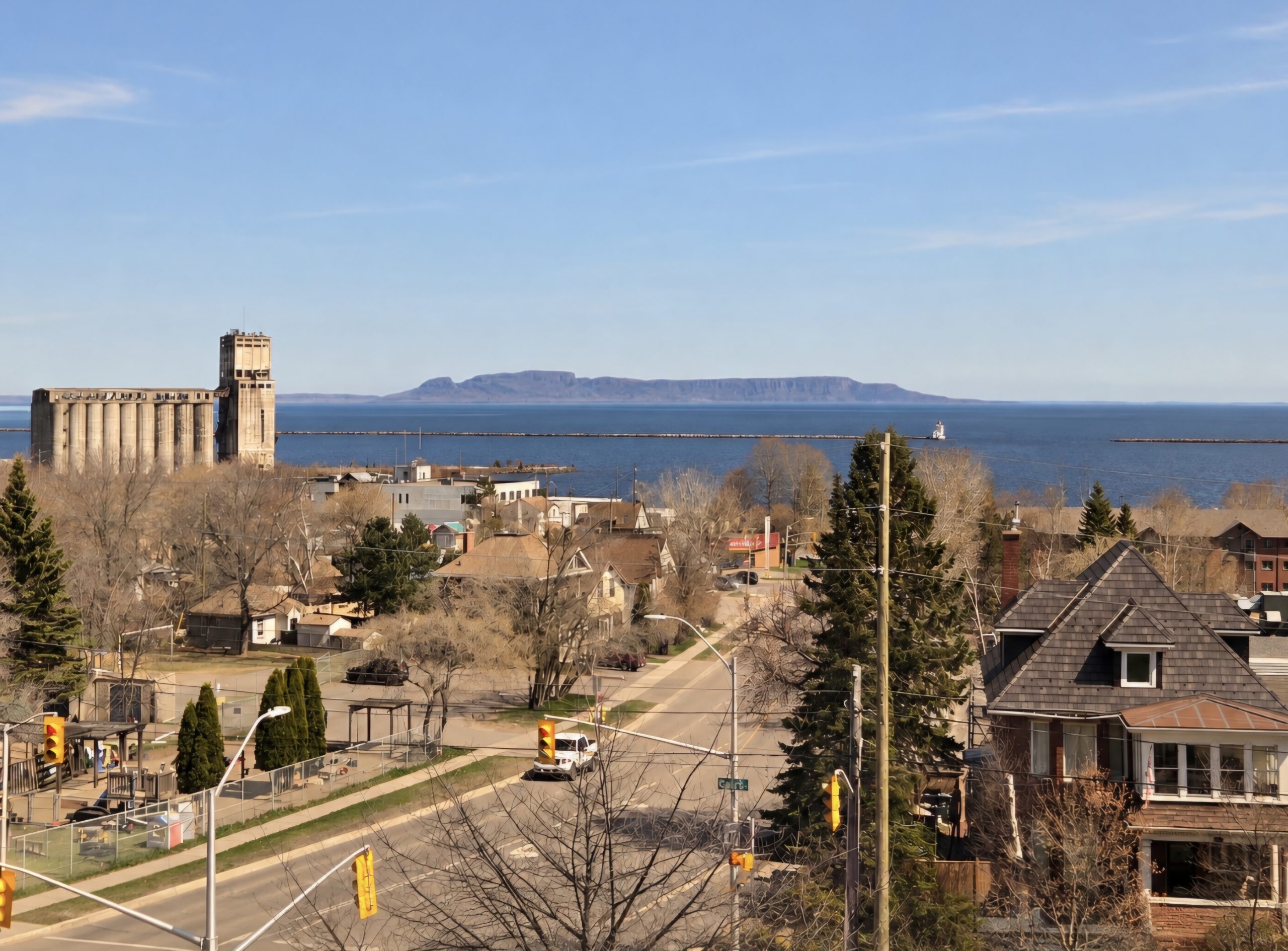

When I relocated to Thunder Bay in 2017, I thought I was moving to a beautiful northern community on the shore of Lake Superior. I was not wrong about the beauty, but I was entirely unprepared for what existed alongside it.
I had toured Detroit in the early 1990s. I remember driving through parts of that city and seeing what prolonged economic and civic abandonment looked like -the empty buildings, damaged
streetscapes, and entire areas left to decline. I am sorry to say that when I first drove through Thunder Bay’s south core, particularly along May and Syndicate, I felt for a moment as though I were back in Motown.
I often say that Thunder Bay is most beautiful when your back is to it and you are facing Lake Superior or the boreal forest. It is a cruel line, perhaps, but the city invites it. Turn toward the lake or the forest and Thunder Bay is breathtaking; turn back toward the city that has been built but neglected, and the view becomes considerably harder to defend.
Thunder Bay can be difficult to explain to people who have never lived here- and even harder to those who do live here. Thunder Bay occupies one of the most beautiful places in Canada, surrounded by forest, cliffs embedded with amethyst, trails, lakes, rivers, waterfalls, and a rich diversity of wildlife. Then we direct visitors through areas that appear to have been abandoned halfway through a municipal recovery plan written sometime around 1987.
I have watched the reaction come over people’s faces. They arrive impressed by Lake Superior and the Sleeping Giant, then encounter boarded buildings, neglected properties, vacant storefronts, and heavily travelled streets that look as though they have been waiting decades for someone to care about what happens to them.
I was shocked by it when I arrived. Thunder Bay was surrounded by astonishing natural beauty, yet many of the places residents passed through every day looked neglected and abandoned. It was as though the scenery had been assigned the job of compensating for everything that had been allowed to deteriorate inside the city limits.
What surprised me almost as much was the certainty with which many lifelong residents told me that Thunder Bay was the best place in the world. I sometimes wondered whether we were looking at the same place.
Perhaps familiarity had taught them to see past conditions that shocked me. Perhaps they were remembering the city as it had once been or experiencing it through family, friendships, and a sense of belonging I had yet to develop. Local pride can inspire people to care for a community, but it can also become a defence against seeing that community clearly.
Thunder Bay has no shortage of official plans describing the city it intends to become. The City plans for housing, economic development, community safety, tourism, downtown renewal, sustainability, and population growth. What remains far less apparent is whether all those plans describe the same city -or whether anyone at City Hall has a coherent vision of what Thunder Bay should become.
The city behind the scenery
The statistical portrait requires little commentary:
- Homicide: Thunder Bay has recorded the highest homicide rate among Canadian census metropolitan areas 17 times since 1981, including eight of the ten most recently reported years. It led Canada again in both 2024 and 2025. Statistics Canada
- Crime severity: Thunder Bay’s 2024 Crime Severity Index was 107.7, compared with 60.7 across Ontario. It rose by eight per cent while the national index fell by four per cent.
- Missing people: Thunder Bay Police received approximately 850 missing-person reports in 2018 -a per-capita rate nearly five times Toronto’s. Police handled more than 400 cases during the first eight months of 2025.
- Human trafficking: From 2014 through 2024, Thunder Bay had the highest average annual rate of police-reported human trafficking among Canadian Census Metropolitan Area’s (CMA): 8.0 incidents per 100,000 people, compared with approximately 1.2 nationally. Statistics Canada
- Toxic-drug deaths: In 2025, 61 people died from opioid toxicity in the Thunder Bay District. The mortality rate of 52.72 deaths per 100,000 people was nearly six times the Ontario average. Thunder Bay District Health Unit
- Homelessness: The October 2025 Point-in-Time Count identified 652 people experiencing homelessness in Thunder Bay, including approximately 180 people sleeping in encampments or elsewhere outdoors. Lakehead Social Planning Council
- Southern Ontario criminal networks: Local investigations repeatedly identify traffickers from Toronto, Brampton, and other southern Ontario communities operating in Thunder Bay. Project Trapper resulted in 46 arrests, including 15 accused from southern Ontario, while Project Valiant seized loaded firearms, cash and approximately $2.7 million in drugs.
Those numbers help explain why I do not feel particularly safe in Thunder Bay. For the first time in my life, I give considerable thought to where I park, where I walk, and when I walk. I have also taken security measures around my home that I never felt compelled to take in the communities where I lived before.
Perhaps some of that is maturity, experience, or heightened awareness, but much of it comes from what I have witnessed since arriving here. During my nine years in Thunder Bay, I have called police and ambulances more often than I had during the entire rest of my life living elsewhere.
It is difficult to leave the house without becoming a witness to somebody’s crisis. Avoiding it altogether requires a determined form of willful blindness.
Suffering as part of the streetscape
When I first moved to Thunder Bay, I cried several times a week. It usually happened in the evening, after I had finally returned to my apartment and had time to absorb everything I had seen during the day.
I missed home, certainly, but those tears were also for the immense suffering that was so visible here. The disparity in Thunder Bay was shocking compared with other communities of this size, and especially compared with the community I had left.
People were in distress everywhere. They were outside stores, on sidewalks, in doorways, or wandering through traffic. Some were asking for help, while others were too unwell, intoxicated, or disconnected from their surroundings to ask.
I began trimming money from my own grocery budget so I could help people I encountered, which happened almost every time I left the house. Eventually, I had to accept that I could not maintain a steady cash flow to help strangers while I was barely getting by myself. I felt guilty anyway.
That feeling of hopelessness becomes part of living in Thunder Bay. We learn to pass suffering on the way to work, the grocery store, the pharmacy, dinner, or even as we are hiking along Boulevard Lake or in Centennial Park, because these disparities are visible upon our natural landscapes too. We learn where people sleep, where they gather, and where the ambulances are likely to be.
The City has responded with encampment plans, outreach services, harm-reduction programs, crisis teams, and temporary shelter proposals. Local staff and community organizations are doing difficult work, but the combined picture increasingly resembles a city learning to administer social collapse more efficiently.
We distribute survival supplies, collect discarded needles, relocate encampments, and debate where people may be permitted to sleep outside. Meanwhile, the language remains reassuring: community safety, wellbeing, inclusion, and belonging.
Thunder Bay has become very good at naming its crises but considerably less successful at ending them.
An angry town
I was also unprepared for the racism I encountered in Thunder Bay. It came from every direction, was often expressed without embarrassment, and created a level of tension I had never experienced so openly in another community.
Thunder Bay is an angry town, in my opinion. I know some residents will dislike hearing that, but arriving here as an outsider was a shock. There was an unfriendliness and suspicion I could feel before I understood all the history beneath it, and I came to believe much of that tension was connected to racism.
Nobody seemed especially interested in pretending everyone liked one another. The hostility appeared in conversations, public institutions, neighbourhood disputes, and comment sections. Eventually, I gave up trying so hard to be likeable because the effort seemed faintly ridiculous in a community where so many people appeared to have selected their enemies before introductions were complete.
But I think I am angry now too.
Any honest examination of Thunder Bay has to begin with its extensively documented history of anti-Indigenous racism. That history involves policing, healthcare, education, public institutions, and everyday encounters. Indigenous families have spent years forcing this community to acknowledge treatment that should have horrified us long before inquiries and reports made denial harder to maintain.
I have also encountered another part of the conversation that has become increasingly difficult to hold. Some residents and students describe institutional environments where hostility toward Jewish people is minimized, while negative generalizations about white people -particularly white men, are defended as education, analysis, or social justice.
Lakehead University’s public policies condemn antisemitism and other forms of hate, but wording on a website cannot tell us everything happening in classrooms, course materials, or interactions between professors and students. Where documentary evidence is limited, I am willing to identify lived experience as lived experience.
I am unwilling to accept that prejudice becomes harmless when directed at a group presumed to possess greater social power. These histories and experiences are not equivalent, but they can coexist. A community serious about opposing racism should be capable of applying that principle in every direction without first consulting the ancestry, religion, sex, or politics of the person reporting it.
I have also met wonderful people in Thunder Bay, including some of the finest people I have ever known. Many work at businesses I frequent, some are colleagues, and others are neighbours I came to know through the fight to protect the Arundel parklands. It took years, however, to meet those people -far longer than I expected when I arrived. There is immense kindness here, but it often exists in pockets surrounded by mistrust, anger, and exhaustion.
What I have seen over those years is that regular folks are often the ones responding most directly to the city’s problems. Eat Local Pizza gives a free pizza to anyone who needs one, The Social has raised money for the Dew Drop Inn, and other local restaurants and businesses regularly turn their sales into support for organizations feeding families and people living in poverty. Residents, neighbourhood groups, businesses, and community organizations keep stepping in where they can. The problem is not a lack of people who care; it is the absence of City leadership capable of turning that concern into a coherent local vision.
Superior, according to ourselves
Then there is the Thunder Bay we photograph, market, and occasionally remember to protect. Thunder Bay has almost everything required to become an extraordinary small northern city: Lake Superior, the boreal forest, a university, a medical school, a law school, a college, a regional hospital, an international airport, a port, short (sort of) commutes, distinct neighbourhoods, and enough people to support urban amenities without many of the burdens of a metropolis.
Boulevard Lake, Centennial Park, Trowbridge Falls, the Cascades, the Current River, the Bluffs, the Nor’Westers, and the Sleeping Giant are woven into daily life here. They provide recreation, habitat, beauty, psychological relief, healing, and places where residents can share the same community without first sorting one another by income, race, or politics.
A person can finish work and be walking through the forest, paddling, skiing, or looking across Lake Superior at the Sleeping Giant before rush hour in Toronto has managed to move three exits. Very few cities can offer that, and no amount of urban design can manufacture the geography Thunder Bay inherited.
Thunder Bay’s institutional language leaves little room for modesty. The City calls itself “Superior by Nature.” Tourism Thunder Bay promotes “Canada’s Premier Outdoor City” and “a city in the wilderness,” while the Community Economic Development Commission has described its work as positioning Thunder Bay as “the best small city in Canada to do business, live, work, and visit.”
Our institutions do not merely promote Thunder Bay. They award it first place.
Curiously, nearly every persuasive argument for Thunder Bay’s greatness leads us away from the city itself: Lake Superior, the Sleeping Giant, the boreal forest, the Nor’Westers, the rivers, trails, parklands, and waterfalls.
Thunder Bay has borrowed much of its identity from a landscape it did not build. That landscape has been doing a tremendous amount of reputational work for the city built inside it.
A vision funded elsewhere
For a time, I thought City Hall was pursuing a deliberate plan to make Thunder Bay denser and more metropolitan. I am no longer convinced there is a coherent vision behind it.
What resembles municipal planning may be City Hall reacting to whichever provincial or federal funding stream is available. The priorities arrive with the money, followed by the language required to explain why they were apparently our priorities all along.
When Ottawa offered Thunder Bay up to $20.7 million through the Housing Accelerator Fund, the city became a housing-acceleration project. Municipal land became “opportunity sites,” neighbourhoods became unit capacity, and success became something that could be counted before the funding deadline expired.
Housing is a legitimate need, and municipalities depend on senior governments to finance work they could never afford through property taxes alone. The danger begins when access to funding replaces local leadership and vision, and the conditions attached to the money begin writing the city’s future.
Thunder Bay should know what it wants to become before the application portal opens. Instead, Thunder Bay’s identity appears to be assembled from whatever governments in Toronto and Ottawa are prepared to purchase from us that year.
This may help explain why Council approved development on publicly owned natural greenspace while vacant, contaminated, and deteriorating properties continued to fester. Repairing neglected areas is slow, complicated, and expensive. It requires dealing with derelict buildings, fragmented ownership, contamination, absentee landlords, and decades of failed revitalization.
Public greenspace is easier. The City already owns it, there are no buildings to demolish, and the community has preserved much of its value simply by leaving it alone. All City Hall has to remove is the public.
Thunder Bay has vacant lots, neglected commercial corridors, underused municipal properties, and two downtown cores that have endured repeated rounds of consultation, branding, and promises of renewal. The City has also identified enough vacant and underused land to accommodate more than 20,000 homes -far beyond the approximately 8,825 additional units projected to be needed between 2021 and 2045 under its high-growth scenario.
Yet 791 Arundel -a publicly owned natural greenspace counted in the City’s parkland inventory, beside Boulevard Lake and Centennial Park, was offered as an Opportunity Site and rezoned for two seven-storey buildings containing approximately 360 units, 90 per cent at market rates and just 10 per cent reserved as affordable for a limited period. Council approved the rezoning despite substantial public opposition, generations of community use, and a petition carrying more than 2,600 signatures. Junot Park, and the smaller park within -the Multiple Sclerosis Park, barely escaped development this year as well. Next time, Junot Park may not be so lucky.
The neglected parts can remain neglected because repairing them is difficult. The beautiful parts become development opportunities because destroying them is comparatively easy.
Thunder Bay says nature is central to its identity. City Hall behaves as though nature is land awaiting its next funding-compatible designation.
The city nobody chose
Thunder Bay says it is welcoming, inclusive, safe, and sustainable. But Thunder Bay is carrying extraordinary suffering, entrenched racial hostility, organized crime, homelessness, addiction, and neighbourhoods that have been allowed to deteriorate for decades.
Thunder Bay says its small size and connection to nature are among its greatest advantages. City Council approved the destruction of publicly owned natural greenspace while vacant and neglected properties continue to wait for the redevelopment promised through one municipal plan after another.
Thunder Bay says it needs housing. That leaves unanswered questions about what kind of housing, at what price, in which locations, for whose benefit, and at what public cost.
Thunder Bay says it wants to grow. Far less has been said about why people would choose to come, why young people would remain, or what kind of community residents will inherit after the latest funding targets have been met.
I don’t think anyone sat down and decided this was the Thunder Bay anyone wanted. The City got here by chasing one funding program after another, leaving another property to rot, managing the next crisis, and selling off public land when it suited the plan of the day.
Lifelong residents defend the Thunder Bay they know and remember. The City promotes the landscape surrounding it. Council follows the money flowing from senior governments, adopting new priorities with each funding announcement while the hardest local problems continue to fester.
Somewhere among all of this, Thunder Bay has been left without a clear direction of its own. The City manages the suffering, postpones difficult redevelopment, approves projects that satisfy the latest program, and continues calling the result progress.
Thunder Bay already possesses the raw materials of an extraordinary small northern city. It needs leadership capable of deciding what should be repaired, what should be built, and what should remain in public hands, even when money is available to do something else.
Until then, Thunder Bay will continue borrowing its identity from the landscape. Its claim to greatness will remain most convincing when our backs are to the city and we are facing Lake Superior or the boreal forest -the very inheritance City Hall seems increasingly willing to place on the bargaining table.

