

Part One of a Northern Hoot examination of population forecasts, housing need, public land and the City’s decision to include neighbourhood parkland among its housing Opportunity Sites.
(Correction -July 19, 2026: An earlier version of this article incorrectly stated that 791 Arundel was not included among the City’s housing Opportunity Sites. The article has been corrected to distinguish the City’s Opportunity Sites initiative from the Housing Land Needs Study, which addressed a different planning question. The central analysis remains unchanged: the City’s Housing Land Needs Study identified sufficient residential land capacity without relying on 791 Arundel.)
Thunder Bay needs housing. That point is not in dispute. What is in dispute -and what City Council must finally confront, is whether Thunder Bay needs to surrender established public parkland to a private developer in order to provide it.
The evidence examined by The Northern Hoot says no.
The City’s own Housing Land Needs Study & Strategy concluded that Thunder Bay already had enough land capacity for 19,803 additional housing units. Even under its highest population-growth scenario, the study estimated that the city would require only 8,825 new units by 2045.
That amounts to identified capacity for 10,978 more homes than the City said it would need.
Neither the 791 Arundel parkland nor 755 Arundel parkland was included in that calculation. Neither property was needed for the City’s consultants to conclude that Thunder Bay had more than double the housing capacity required under its highest growth forecast.
“The study found that there is sufficient land available to meet the housing needs in all growth scenarios through a combination of development on vacant and underutilized land, intensification of existing urban low-density housing areas, and the development of some areas currently zoned for future development….” ~ Thunder Bay Housing Land Needs Study & Strategy, 2024
Yet 791 Arundel -a neighbourhood parkland and part of the larger Boulevard Lake greenspace complex, is now the subject of a major private development proposal by Terralux.
And newly released plans appear to point toward the adjacent 755 Arundel parkland as well.
Although 791 Arundel was included among the City’s housing Opportunity Sites, that fact does not establish that the property was required to meet Thunder Bay’s projected housing need. The Housing Land Needs Study had already identified more than sufficient capacity without including either 791 or 755 Arundel in its calculation. The appearance of a potential access connection through 755 Arundel also raises separate questions about the future of the adjoining parkland.
FORECASTS ARE NOT FACTS
Population projections are important planning tools but they are not prophecies.
Thunder Bay’s Housing Land Needs Study presents three possible population scenarios for 2045:
- a low-growth population of 108,637;
- a medium-growth population of 113,636;
- a high-growth population of 124,959.
The high-growth scenario is the one used to calculate the greatest housing requirement: 8,825 units.
But that forecast was not produced through a detailed calculation of exactly how many immigrants, international students, temporary workers, births and deaths Thunder Bay would experience.
Instead, the consultants took Greater Sudbury’s five-year population growth rate of 2.8 per cent (2016–2021) and applied it repeatedly to Thunder Bay, concluding that Sudbury provided a reasonable comparison for projecting future growth.
That assumption deserves scrutiny. Greater Sudbury is located approximately 1,000 kilometres southeast of Thunder Bay, with stronger transportation links to Southern Ontario and a different regional geography and economic context. Whether its recent growth rate is an appropriate model for forecasting Thunder Bay’s future population is a legitimate planning question.
Ultimately, a planning assumption is not a demonstrated future outcome. A population forecast remains a projection built on assumptions. It does not tell Council which land it must sell, which neighbourhood it must disrupt, or which park it must sacrifice. Those are policy decisions that require their own justification.
THE LAKEHEAD PROJECTION IS REGULARLY MISUNDERSTOOD
The City has often referred to a separate Lakehead University population projection, 20-Year Population Projection for the City of Thunder Bay, prepared in September 2024 by Dr. Camillo Lento and Dr. David Richards.
That report estimates that Thunder Bay’s population could reach 151,002 by 2041. On the surface, this appears to suggest explosive growth.
But most of the difference is already present before the forecast begins.

The Lakehead researchers began with a higher 2021 population estimate of 131,826, rather than the official Census count of 108,843, arguing that the Census undercounted Indigenous residents in Thunder Bay.
Using that higher starting point, the report projects the population will grow to 151,002 by 2041 -an increase of 19,176 people. By comparison, the City’s high-growth scenario projects an increase of 16,116 people between 2021 and 2045.
The Lakehead report may make a persuasive case that Thunder Bay’s population has been underestimated. However, if those residents already live here, they already require housing. Recognizing an existing population is different from forecasting thousands of new residents who will need homes in the future.
The authors also caution that their forecast relies on assumptions drawn from data from different years and is intended to show a general direction -not to predict an exact population for any particular year.
Council should not treat that projection as proof that every available piece of public land must be opened to development.
ONE OF THE CITY STUDY’S GROWTH ASSUMPTIONS HAS ALREADY CHANGED
The Housing Land Needs Study gives significant attention to immigration and international students.
The Study reports that 843 immigrants came to the Thunder Bay Census Metropolitan Area between 2021 and 2022, along with a net increase of 643 non-permanent residents. It also notes that deaths exceeded births during that period and that the population would have declined without immigration.
International students were treated as a particularly important source of housing demand.
The study reports that combined international enrolment at Lakehead University and Confederation College peaked at 4,440 students in 2020. The consultants predicted that international-student numbers would soon return to or exceed that peak, continuing to put pressure on the city’s housing supply.
That prediction was made before a major reversal in federal immigration policy.
Canada introduced a cap on international students in 2024. The federal government reports that the number of study-permit holders fell from more than one million in January 2024 to approximately 725,000 by September 2025. For 2026, Ottawa expects to issue 155,000 permits to newly arriving international students, with the remainder of its permit target largely consisting of extensions for students already here.
The federal 2026–2028 Immigration Levels Plan also aims to reduce temporary residents to less than five per cent of Canada’s population by the end of 2027. It sets targets of 385,000 new temporary-resident arrivals in 2026 and 370,000 in each of 2027 and 2028, including substantially reduced student-arrival targets.
Post-graduation work-permit rules have also been tightened. Most applicants now face language requirements, while many graduates of college and other non-degree programs must complete studies in an eligible field connected to labour-market needs. Graduating from a designated institution no longer guarantees eligibility for a post-graduation work permit.
These changes do not mean that immigration to Thunder Bay will stop. Nor do they eliminate the need for housing.
They do mean that the City study’s confident prediction that international-student numbers would return to or surpass their former peak must be revisited using current information from Lakehead University and Confederation College.
Before Council uses population pressure to justify the permanent loss of parkland, it should know whether the pressure being cited still exists at the scale predicted.
EVEN THE HIGH FORECAST DID NOT REQUIRE ARUNDEL
This is the central fact.
The Housing Land Needs Study calculated capacity from two sources:
| Land supply examined | Estimated capacity |
| Vacant and underutilized properties | 15,074 units |
| Ten priority Future Development sites | 4,729 units |
| Total | 19,803 units |
The study compared that capacity with the 8,825 homes required under its highest growth scenario.
The result was an estimated surplus capacity of 10,978 units.
The consultants concluded that Thunder Bay had sufficient vacant, underutilized, and Future Development land to meet housing demand over the following 20 years -even if the high-growth scenario occurred.
And they reached that conclusion without the 791 Arundel parkland and without the 755 Arundel parkland. Neither address appears in the study’s land-capacity calculation, and neither was among the ten Future Development sites used to estimate the City’s projected housing capacity.
The study did examine six small City-owned parkettes, representing a theoretical total of 55 homes. But it placed those parkettes under a section explicitly identifying properties not counted in the inventory of vacant and underutilized land.
Those parkettes were small Urban Low-Rise properties ranging from approximately one-eighth of a hectare to less than one hectare. They were not the 791 Arundel parkland, a much larger Community-zoned park property.
The consultants also recorded that only 16% of survey participants supported using existing greenspace for housing and recommended careful consideration before disposing of parkland.
“Due to the likelihood of neighbourhood opposition, it is recommended that the City carefully consider the disposal of any parkland against parkland allocation metrics and make improvements to area parklands to mitigate impacts of parkland reduction.” ~Thunder Bay Housing Land Needs Study & Strategy, 2024
This was not a study telling Thunder Bay to build in its parks, but rather a study demonstrating that the City had ample alternatives.
THE CITY DID NOT RUN OUT OF LAND
The public has repeatedly been presented with a false choice:
Either approve increasingly aggressive development proposals OR accept that Thunder Bay will fail to house its current and future population.
But the City’s own numbers do not support that framing.
The City identified enough land capacity to exceed its highest projected housing requirement by more than 10,000 units.
That inventory included thousands of opportunities through:
- existing vacant residential properties
- underused urban properties
- additional units on existing low-rise lots
- City-owned vacant land
- intensification
- surface parking lots already zoned for housing
- and large Future Development areas
The report also examined additional sources of housing that were not included in the 19,803-unit calculation, including commercial conversions, some parking lots, industrial conversions, and future rezonings.
“The potential for conversion of vacant commercial lots to residential purposes could provide a significant number of housing units in Thunder Bay and help to revitalize certain parts of the city.” ~Thunder Bay Housing Land Needs Study & Strategy, 2024
The City therefore has more potential capacity than the headline figure alone indicates.
Not every property will be developed. Some sites face legitimate constraints related to servicing, ownership, environmental conditions, or market demand.
Those constraints do not demonstrate that the 791 Arundel parkland was required. They required Council to evaluate competing options, establish priorities and justify the decision to pursue this parkland.
WHY ARUNDEL?
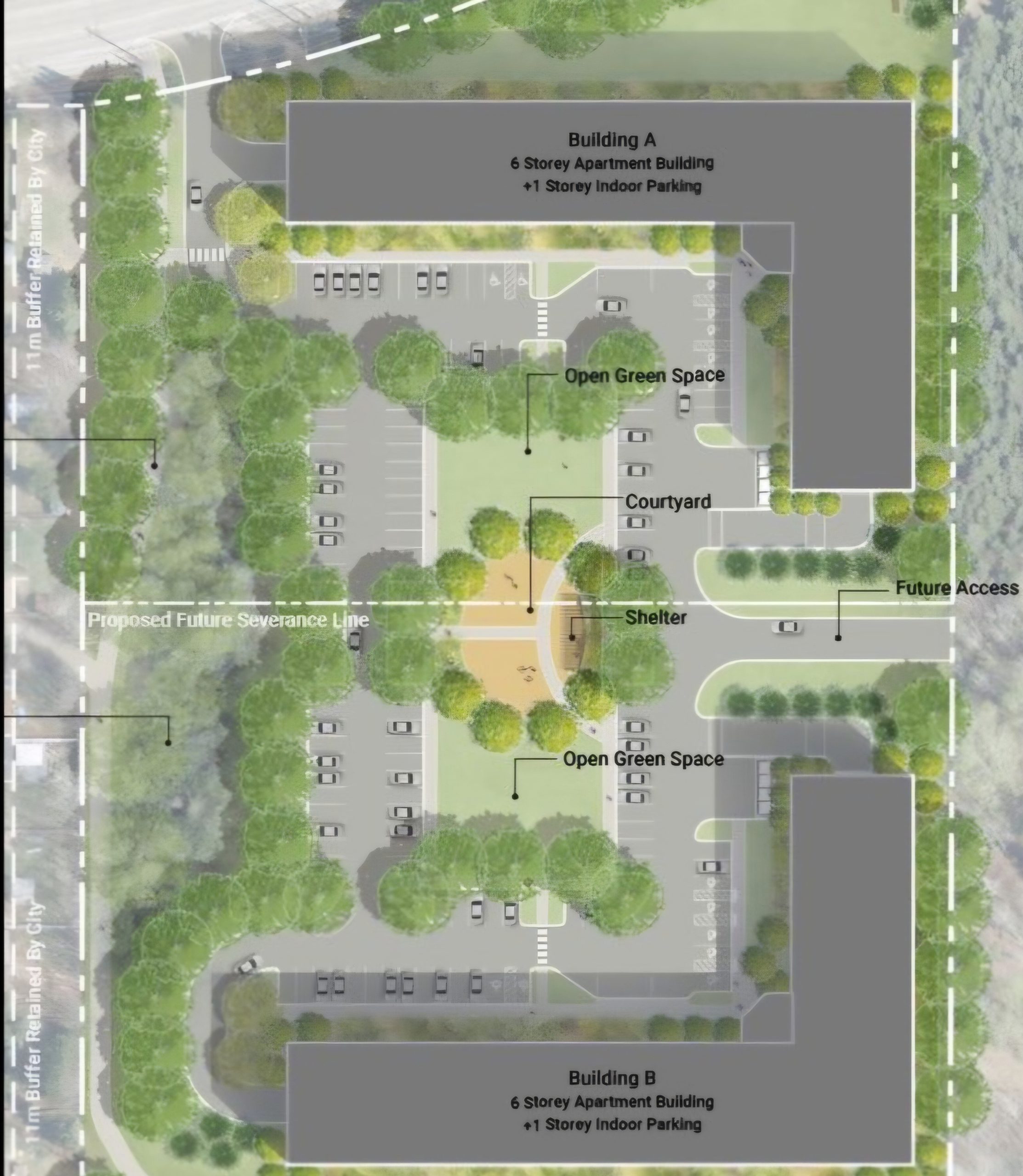
The City included 791 Arundel among the properties promoted through its housing Opportunity Sites initiative. Terralux subsequently advanced a proposal for the property through that process.
The Opportunity Sites initiative identified City-owned properties that could be offered for housing proposals. The Housing Land Needs Study performed a different function: it estimated how much residential capacity Thunder Bay already possessed and how much housing it could require under several growth scenarios.
The Housing Land Needs Study did not rely on 791 Arundel to meet that requirement. Its consultants calculated capacity for 19,803 units without including the property—10,978 more units than the 8,825 required under the highest-growth scenario.
Of particular concern is the revised Terralux site sketch, which depicts a potential road connection extending toward the adjacent 755 Arundel parkland. That property was not included in the Housing Land Needs Study’s land-capacity calculation. The City should publicly clarify whether the access shown is merely conceptual or reflects any future intention for 755 Arundel.
Which leads to an obvious question:
How far ahead have the City and Terralux been planning?
QUESTIONS THAT REMAIN
The Opportunity Sites process provides part of the decision trail: 791 Arundel was among the City-owned properties offered for housing proposals, and Terralux submitted the proposal that advanced. However, the public record still leaves important policy and land-use questions unanswered.
Those questions are no longer about whether an Opportunity Sites process existed. They concern why this particular parkland was included, what evaluation was used to weigh its public value against its development potential, and what -if anything, is contemplated for the adjoining 755 Arundel property.
Those questions include:
- What criteria were used to place 791 Arundel on the Opportunity Sites list?
- How was the property’s existing use as public parkland evaluated?
- What alternatives were considered before parkland was included?
- What weight was given to the Housing Land Needs Study’s finding that the City already had substantial surplus capacity?
- What parkland-allocation analysis was completed before 791 Arundel was advanced?
- What public consultation occurred before the property was offered for development?
- What valuation, appraisal and proposed sale terms exist?
- When was 755 Arundel first considered in relation to the proposal?
- What discussions have occurred about road or development access through 755 Arundel?
- Is any future sale, rezoning or development of 755 Arundel being contemplated?
The existence of an Opportunity Sites process does not eliminate the need for transparency about the criteria, evaluations and policy choices behind it. Residents should be able to understand not only how Terralux’s proposal advanced, but why this parkland was offered for development despite the City’s documented surplus of potential housing capacity.
The City should also clearly disclose whether the potential access shown toward 755 Arundel reflects only a conceptual design choice or any broader intention for the adjoining public property.
EXPERTS ADVISE. COUNCIL DECIDES.
Some members of Council appear willing to defer to City administration and consultants as though the word “expert” removes their own responsibility.

It does not.
Experts can provide population scenarios. They can calculate housing capacity. They can identify where development is technically possible.
They cannot decide what Thunder Bay values.
The Housing Land Needs Study did not identify 791 Arundel as necessary to meet the City’s projected housing requirement, nor did it direct Council to include the parkland among the Opportunity Sites. It did not include Arundel in the capacity used to meet the City’s projected need.
The decision to consider selling and rezoning the 791 Arundel parkland belongs to elected officials. Council remains accountable for that choice.
THE QUESTION COUNCIL MUST ANSWER
Thunder Bay needs affordable, appropriate, and well-located housing.
But Terralux’s proposal is not automatically justified merely because it contains housing units.
Council must demonstrate why this particular public property is required when:
- the City identified capacity for 19,803 homes
- its highest projected requirement was 8,825
- 791 and 755 Arundel were not needed to produce that capacity
- international-student and temporary-resident policy has materially changed
- and Council has not yet clearly explained why public parkland was included and prioritized despite the substantial alternative capacity identified in the City’s own housing study.
The question is not whether housing can be built at 791 Arundel.
The question is:
Why should public parkland be sold and rezoned for the Terralux proposal when the City’s own evidence shows that Thunder Bay already has more than enough potential housing capacity?
Until Council answers that question openly and with evidence, it does not have a responsible basis for approving the rezoning.

