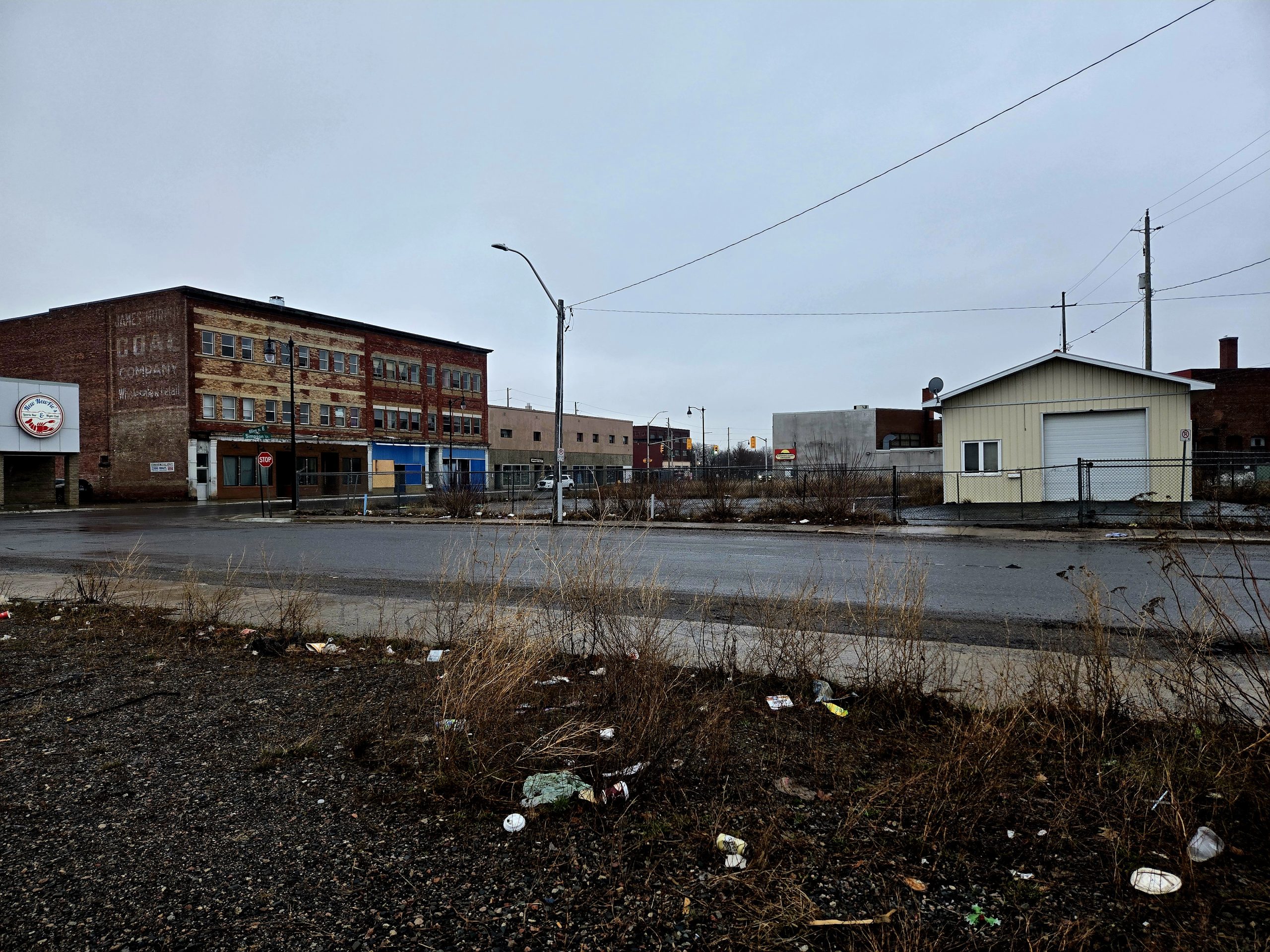

From a few storeys up, some say, Thunder Bay’s Simpson Street is transformed into a tranquil and visually breathtaking experience.
Brian Hamilton, McKellar Ward Councillor remarked at his ward meeting on the evening of April 29th, “I will say this of the south core, once you get more than three storeys up, it is beautiful. You see the river, the lake, the islands. We are three stories from paradise.”
But at street level, on Simpson Street, that view feels a long way off.
*****
Revitalization isn’t a slogan -it’s a responsibility. And right now, the South Core is being left to the mercy of the market.
At a recent McKellar Ward meeting, I asked a simple question: How is the City using its own tools to fix what’s broken in the South Core? The answer should have been straightforward because Thunder Bay has the plans, the incentives, and it has identified the property.
Instead, what emerged was something far less reassuring: no clear line of sight between policy and action, and no ownership of outcomes. However, Thunder Bay does not lack direction -on paper.
The Downtown Fort William Strategic Renewal Plan calls for reinvestment in the South Core, explicitly pointing to vacant and underused land as the foundation for change. The Strategic Core Areas Community Improvement Plan provides incentives for infill, mixed-use development, and private investment in precisely the corridors of Simpson, May, Brodie, Victoria.
The tools and sites exist, and the need is undeniable. Yet, meaningful revitalization has not followed.
At this week’s meeting, when I asked of McKellar Ward Councillor, Brian Hamilton, to provide how the City is deploying those tools -whether derelict properties are being targeted, whether expropriation or vacant building processes are being used, the response was that Council sets policy, while administration handles implementation. There was no clear accounting of which properties are being addressed, which tools are being used, or how success is measured. A rough goal of “10 to 15 houses or derelict properties” was offered without detail.
That is not a strategy. Nor oversight. Nor accountability.
Elected officials are not simply authors of policy -they are stewards of its results.
Responsibility does not end when a plan is passed -it begins there. If Council does not track implementation, does not ask where the tools are being applied, and does not measure outcomes against intent, then the public is left with process in place of progress.
This is significant because the stakes in the South Core are not cosmetic -they are structural.
Several residents, in attendance at this week’s meeting, spoke about litter, potholes, planting flowers, bridge repair, and creating a parkette. These are visible improvements, and they have value. But they are not a response to the realities people are living with: addiction, housing instability, persistent poverty, and the erosion of safety in public spaces.
You cannot landscape your way out of systemic decline, and you cannot fix structural problems with surface treatments.
Revitalization, if it is to mean anything, must be understood for what it is -a response to social disparity. Revitalization is how a city directs investment into the places that have been left behind; how it restores economic activity; stabilizes housing; supports safety; and rebuilds dignity through presence and design. Revitalization is not separate from these issues -it is one of the primary ways to address them.
Yet, when the conversation turned to housing, the gap between intent and action became impossible to ignore.
The City has already identified multiple Opportunity Sites in McKellar Ward: the block bounded by Miles, North, and Simpson; the Victoria and Simpson intersection; two sites at Brodie and Arthur; and parcels along May Street. These are not theoretical -they are mapped, recognized, and central to any credible revitalization effort.
But they are not being actively advanced.
Instead, as was acknowledged at the meeting, developers are choosing easier land -sites that are clean, uncomplicated, and ready to build. That reality was articulated by, Hamilton, who noted that green space and parkland are more desirable to developers, remarking of three such sites that Mayor and Council recently voted in favour of selling, “Those were the three most attractive sites- those are greenfield sites, there’s no contamination, and they’re ready to build.”
There is no indication that the City’s identified Opportunity Sites in the South Core are unbuildable, yet they remain largely unadvanced while development continues to be directed toward easier land- green space and parkland. Brownfield sites may be more complex to develop, but that is precisely why public policy, incentives, and leadership are meant to direct investment there. The South Core, characterized as a “tougher market”, requires stronger incentives and coordinated effort -not deferral.

And this is the crux of the issue. The City is not directing development -it is deferring development to the market. Markets, left alone, do not fix inequity -they scuttle around it. Which is why the idea -advanced in a memorandum by Councillor Kasey Etreni, of including additional City-owned land, including potential parkland, as Opportunity Sites is not just misguided, but counterproductive.
When parkland and green space are placed alongside more complex urban sites as development options, the outcome is predictable. Developers will choose the path of least resistance. They will build where it is easiest, fastest, and most profitable.
Developers will not choose Simpson Street or the South Core, and they will not choose revitalization.
Juxtaposing green space and parkland with brownfields as development sites, undermines the City’s own objectives. This is an approach which removes the very pressure that would push investment into underused corridors; weakens the purpose of its own incentives; and risks trading long-term public assets -green space, parkland, community-used land, for short-term development gains that could have been achieved elsewhere.
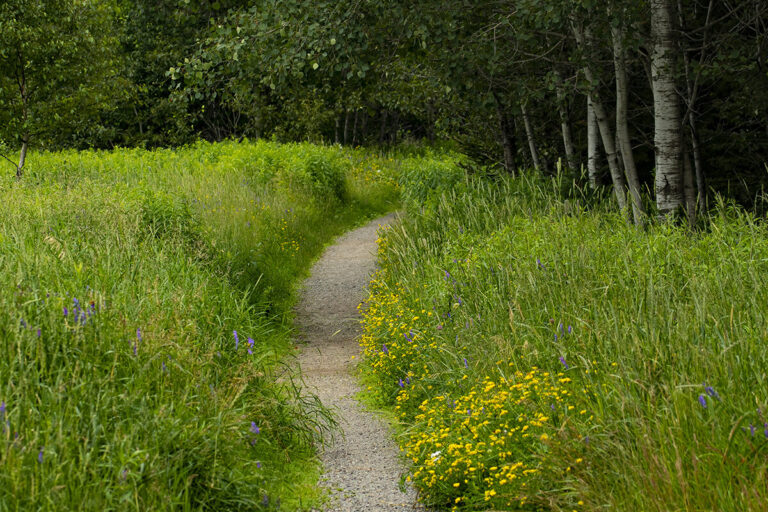
Green space is not surplus. Parkland is not spare inventory.
These are living systems -environmental, social, and community. These are the places that absorb water, support biodiversity, provide natural spaces for connection and recreation, and hold neighbourhoods together. Once lost, they are not meaningfully replaced.
A city serious about revitalization does not offer up its strongest, most stable spaces first. It directs development to where renewal is needed most, and it does the harder work of making those sites viable.
The South Core has that potential. Even its critics acknowledge it -just a few storeys above ground, the views open to the river, the lake, and the islands beyond. It is, quite literally, a place where value increases with vision.
But vision requires choice.
Vision requires Council to move beyond enabling conditions and into active direction -to prioritize sites, strengthen incentives, coordinate land use, and hold itself accountable for outcomes. Vision requires a willingness to say: this is where we build, and this is how we will make it happen.
But that is not happening in Thunder Bay.
Instead, the City is maintaining, discussing, and waiting -while the market selects the easiest path, and the areas most in need of reinvestment remain unchanged.
Thunder Bay does not need more plans.
Thunder Bay needs leadership that does not defer responsibility but owns it, and a revitalization strategy that is not aspirational but operational. Thunder Bay especially needs a commitment, from leadership and community members, to cherish and protect what is good in our community -our parklands and green spaces, while directing growth to where it is urgently required.
We may be only a few storeys away from paradise but until we choose to build where it is needed most, we remain firmly at the ground level -on Simpson Street.